

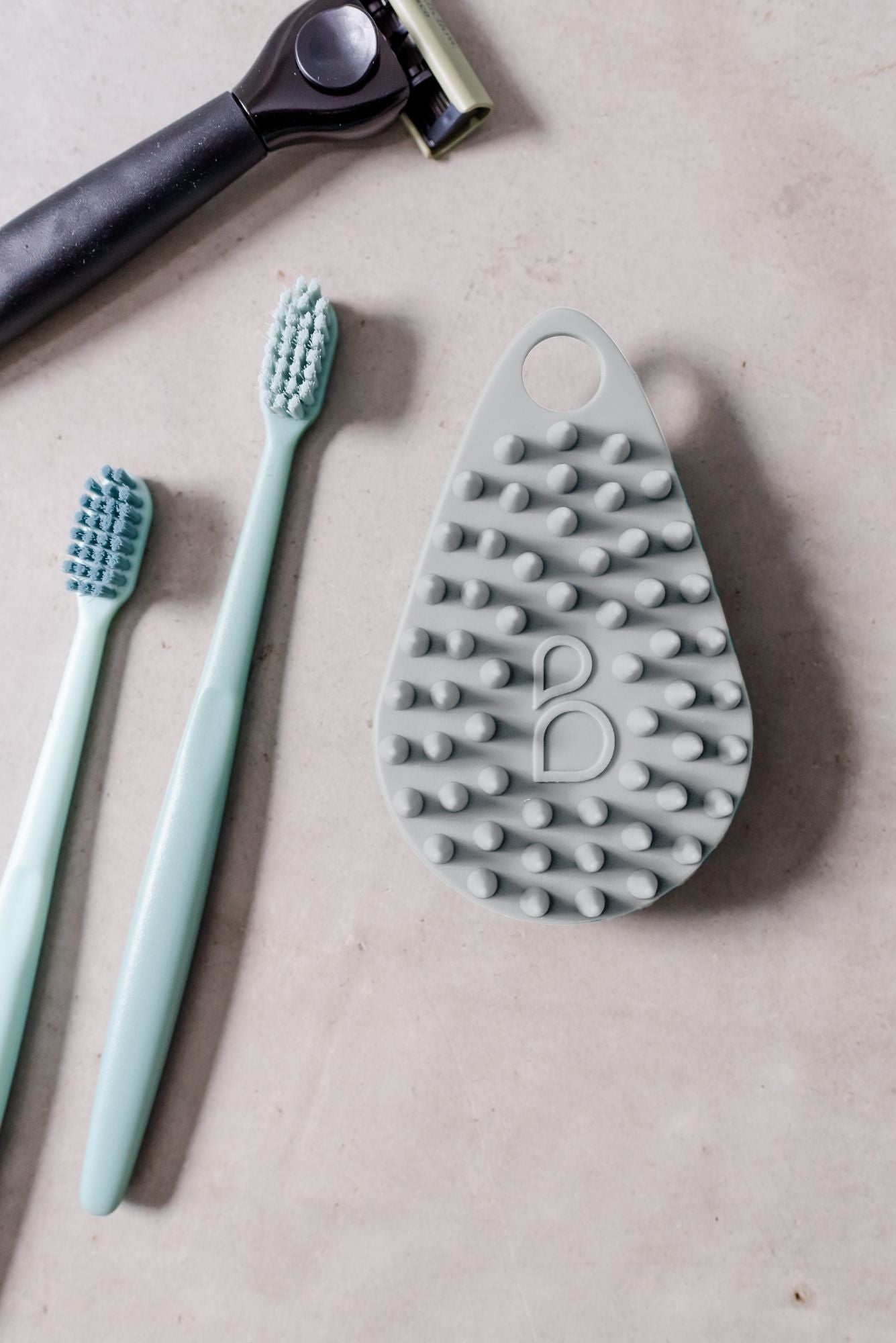
TPE and silicone feel similar in your hand. Both are soft, flexible, and non-porous. But the material differences matter when you're choosing a tool that lives in your shower and contacts your skin daily.

Medically reviewed by Michael Bair, PA-C
Written by Ryan Payne · May 2026
What TPE Is
Thermoplastic elastomer (TPE) is a class of materials that combine the flexibility of rubber with the processability of plastic. It's used in medical devices, food-contact products, and personal care tools because it's non-toxic, free of phthalates and BPA, and can be molded into precise shapes that hold their form under repeated use and cleaning.
The scrub-dub® is made from TPE with a zinc-based antimicrobial compound incorporated into the material. This compound is designed to protect the scrubber from the odor and material degradation that happen when moisture and organic residue interact with a tool over time, the same reason your shower tools sometimes start to smell even after rinsing. The material property protects the product itself; it doesn't make therapeutic claims about skin or scalp health.
How TPE and Silicone Compare
Flexibility and feel. Both materials are soft and pliable. Silicone tends to be slightly slicker to the touch; TPE has a bit more grip, which some people prefer when wet. For a body scrubber that needs to maintain contact with skin under water pressure, the grip difference is noticeable.
Heat resistance. Silicone is generally more heat-stable at extreme temperatures than TPE. For a shower tool that operates in warm water (not industrial-scale heat), both materials perform equally well. Neither degrades at typical shower temperatures.
Recyclability. This is a meaningful difference, with an important nuance. TPE can be recycled through plastics recovery programs that accept thermoplastics, it's not a thermoset material, meaning it can be remelted and reprocessed. Silicone cannot be recycled through standard plastics streams; it requires specialized silicone recycling, which is rarely available to consumers in the US. TPE is the more practically recyclable option, though it requires specialty recycling rather than curbside bins in most municipalities.
Cost. At the material level, TPE is typically less expensive to manufacture than silicone. Whether that translates to product price depends on design complexity, tooling, and brand positioning rather than material cost alone.
Antimicrobial properties. Standard silicone has no antimicrobial properties. The zinc infusion in scrub-dub's TPE gives it material-level protection against odor and degradation. Off-brand silicone scrubbers don't have this, which is why some silicone tools develop an odor over time even though they're non-porous.
Why the Dual-Sided Design Matters
Most silicone body scrubbers are single-sided: bristles for body exfoliation only. The scrub-dub's design puts a bristle side (body) and a spike side (scalp) on the same tool. The spike structures are specifically shaped to work through hair and contact the scalp surface, distributing shampoo evenly, loosening buildup, and stimulating follicle circulation, functions a standard silicone scrubber can't perform.
If you're only comparing the body-scrubbing sides, the materials are comparable. The functional gap is the scalp side, which most silicone alternatives don't include at all.
Frequently Asked Questions
Is TPE safe for skin contact?
Yes. TPE is used in medical devices, baby products, and food-contact applications because of its safety profile. It's free of phthalates, BPA, PVC, and latex. The zinc-based antimicrobial compound in scrub-dub's TPE is the same class of material used in zinc oxide-containing products widely applied to skin.
Will a TPE scrubber last as long as a silicone one?
Both materials are durable under normal shower conditions. The practical durability question is bristle integrity, both TPE and silicone bristles soften over time with daily use. Annual replacement is the standard recommendation for either type, based on bristle effectiveness rather than material failure.
Can I put a TPE scrubber in the dishwasher?
Yes. TPE handles the heat of a standard dishwasher cycle without warping or degrading. Top rack is recommended. Let it air dry fully before the next use.
Why not just use a silicone scrubber from a drugstore?
The functional differences are: no zinc-based odor protection, single-sided design (body only, no scalp function), and no dual-use capability. If body scrubbing is the only goal, a standard silicone scrubber works adequately. If you're also managing scalp buildup, dandruff, or hair health, the scalp side of a purpose-built dual-sided tool does something a flat silicone pad cannot.
See the Difference
The Scrub-Dub is the dual-sided version — zinc-infused TPE, bristles for body, spikes for scalp, made in the USA. If you've been comparing silicone scrubbers, this is what they're missing
SHOP THE SCRUB-DUB30-day guarantee. No return required.