

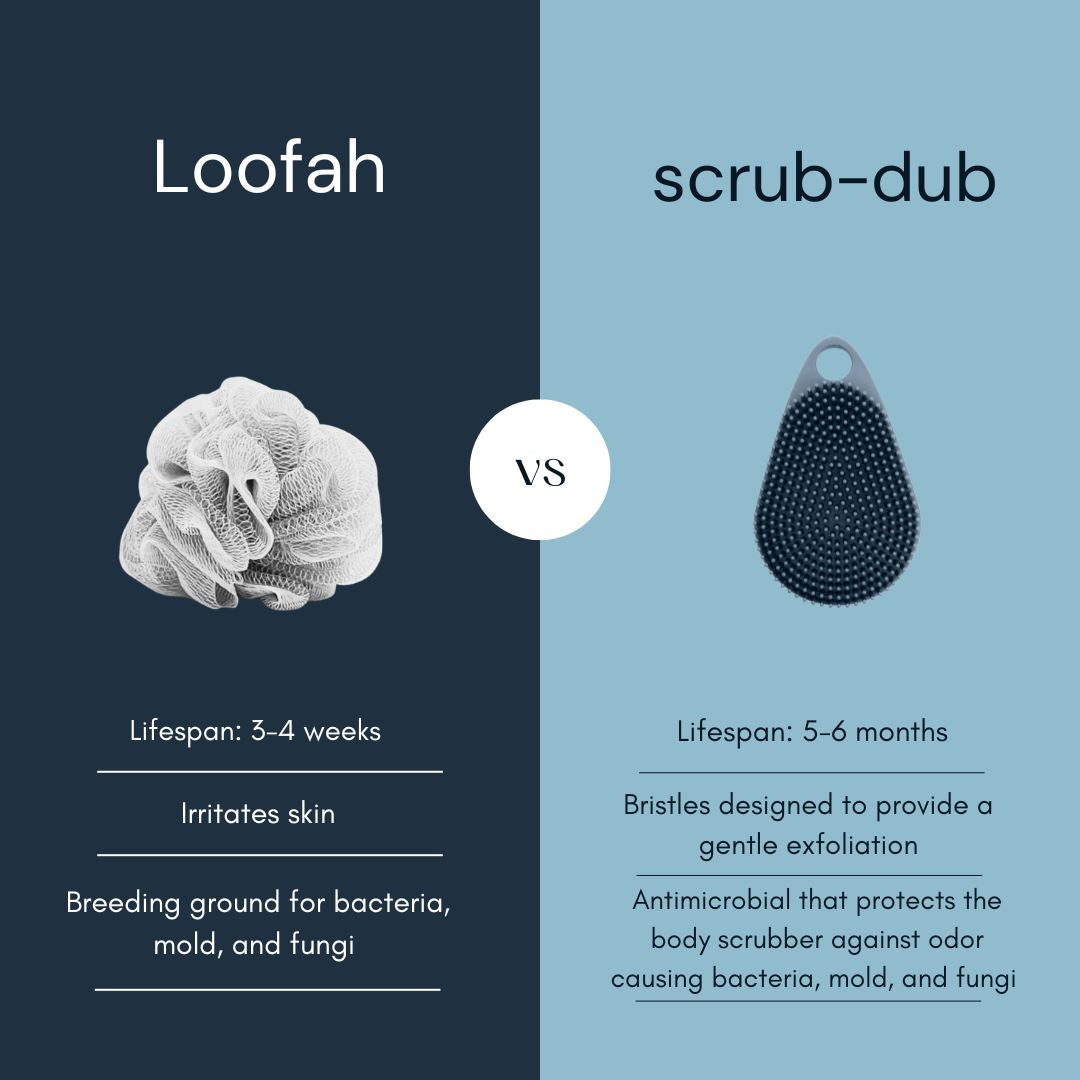
A silicone scrubber is more hygienic than a loofah, and the reason is simple: silicone is non-porous, so it dries between showers while a loofah's fibers stay damp and trap bacteria. That's why dermatologists say to toss a loofah every 3 to 4 weeks but let a non-porous scrubber last for months. The Scrub-Dub® works on that same non-porous principle, with a zinc antimicrobial additive and a scalp side most silicone scrubbers don't have.

The Problem with Loofahs
Loofahs, whether plastic mesh or natural luffa, share a structural problem: their fiber networks trap water, dead skin cells, and soap residue deep inside layers that don't dry between showers. A 1994 study in the Journal of Clinical Microbiology found that loofahs harbor gram-negative bacteria like Pseudomonas and Klebsiella that transfer to skin during use. The material stays wet for hours, which is exactly the environment bacteria need to multiply.
The recommended replacement window of 3 to 4 weeks reflects the reality that loofahs can't be reliably cleaned, the interior stays damp and the fiber structure provides too much surface area for microbial growth to control. Dermatologists aren't being conservative. They're acknowledging the material's limitations.
Natural luffa has the same structural problem. It biodegrades, which is genuinely better for the environment than plastic mesh. But it degrades in the shower too, often faster than plastic mesh, and carries the same bacterial colonization risk.
How Non-Porous Materials Work Differently
The Scrub-Dub is made from thermoplastic elastomer (TPE), a non-porous material. It doesn't absorb water. After a shower, it dries completely in about 30 minutes hanging in a typical bathroom. There's no wet interior for bacteria to establish in, the primary condition for microbial colonization in shower tools is sustained moisture, and non-porous materials remove it.
The zinc-based antimicrobial compound incorporated into the TPE is designed to protect the scrubber itself from deterioration, from the odor and breakdown that happens when materials degrade. This is the treated article distinction: the material property protects the product, not the user. The more significant hygiene advantage is the non-porous structure that prevents colonization from establishing in the first place. We walk through the full material evidence on The Science page.
Loofah vs. Silicone Scrubber: The Honest Comparison
If you're choosing between a loofah and a silicone body scrubber, the silicone wins on hygiene. Silicone is non-porous like TPE, so it doesn't soak up water or hold bacteria the way a loofah's fibers do, and a silicone scrubber lasts months instead of weeks.
So the real divide isn't loofah versus silicone. It's porous versus non-porous. A loofah is the outlier, and almost any non-porous scrubber is a hygiene upgrade over it.
Between silicone and the Scrub-Dub, the gap is narrower and comes down to three things: the Scrub-Dub's TPE carries a built-in zinc antimicrobial compound that protects the tool from odor and breakdown, its bristles stay effective across a full year, and it adds a scalp side that no flat silicone scrubber offers. We break the materials down further in TPE vs. silicone body scrubber.
Exfoliation: How They Compare
A new loofah exfoliates effectively. The mesh structure creates friction against skin that removes dead cells well. The problem is that effectiveness declines as the loofah degrades, after 2 to 3 weeks, a loofah is softer, less structured, and less effective at exfoliation, right around the time dermatologists say to replace it anyway.
The Scrub-Dub bristles are designed for consistent exfoliation across a full year of use. The bristles are soft enough for sensitive skin and firm enough to remove dead skin without scratching. The scrubbing surface doesn't degrade in the shower the way fiber does, so exfoliation quality stays relatively consistent over the year.
The Scrub-Dub also adds the scalp side, spike structures that distribute shampoo across the scalp, loosen product buildup, and stimulate blood circulation to follicles during washing. A loofah can't do this at all.
The Practical Comparison
| Standard Loofah | Silicone Scrubber | Scrub-Dub | |
|---|---|---|---|
| Replacement frequency | Every 3–4 weeks | Every 6–12 months | A full year |
| Dries between uses | No, retains moisture | Yes, non-porous | Yes, non-porous |
| Antimicrobial material | No | No (most) | Yes, zinc-infused TPE |
| Scalp use | No | No | Yes, spike side |
| Material | Plastic mesh or natural luffa | Silicone rubber | Zinc-infused TPE |
| Recyclable | Generally no (mesh); yes (natural luffa) | Yes, through specialty recycling | Yes, through specialty recycling |
Frequently Asked Questions
Is a natural loofah better than a plastic mesh loofah?
From an environmental standpoint, natural luffa is biodegradable, which is a genuine advantage. From a hygiene standpoint, both share the same structural problem: fiber networks that retain moisture and support bacterial growth. If you prefer natural loofahs for environmental reasons, the replacement window (3 to 4 weeks) is the same or shorter, since natural luffa degrades faster in humid conditions.
Can you really clean a loofah?
You can reduce surface bacteria by soaking a loofah in diluted bleach or vinegar solution, or microwaving a wet one for 2 minutes. These methods address surface contamination but don't reach the interior layers where most of the bacterial load actually lives. Cleaning it this way buys a little time but doesn't change the fundamental material limitation.
Why do dermatologists keep recommending loofah replacement so frequently?
Because the evidence supports it. The bacterial colonization documented in research isn't theoretical, it's a predictable result of the material properties. The recommendation reflects a straightforward acknowledgment that a fiber tool that stays wet for 20 hours between uses will harbor microbial growth regardless of how carefully it's rinsed.
Does the Scrub-Dub work as well on dry skin conditions like eczema?
The TPE bristles are soft enough that people with eczema commonly use the Scrub-Dub without the irritation they experience from rougher materials. For active flares or broken skin, use very light pressure and avoid the affected areas. The non-porous material doesn't transfer residue between showers the way a colonized loofah might, which is an additional consideration for people managing body acne or other skin conditions sensitive to microbial exposure.
Is a silicone scrubber better than a loofah?
For hygiene, yes. Silicone is non-porous, so it dries between showers and doesn't trap bacteria in its surface the way a loofah's fibers do, and it lasts months instead of weeks. The Scrub-Dub uses TPE, a non-porous material in the same family, and adds a zinc antimicrobial compound plus a scalp side that flat silicone scrubbers don't have.
Which should you use, a loofah or a silicone scrubber?
If the choice is only between those two, the silicone scrubber is the more hygienic pick. The more useful way to think about it is porous versus non-porous: a loofah holds moisture and bacteria, while any non-porous scrubber dries out and stays cleaner between uses. That's the real dividing line, not the specific brand.
Choose Your Set.

Single
The full Scrub-Dub experience. Spike side for your scalp, bristle side for your body.
$25
Duo Pack
One for you, one for your partner or guest bathroom. Two scrubbers so your whole household makes the switch.
$40 $20 each, save $10
Trio Pack
Keep two at home, gift one, or stock the whole house and never run out. The best value per scrubber.
$57 $19 each, save $18